pickleball

A Complete Beginner’s Guide

Pickleball is one of the fastest-growing sports in India & around the world, and for good reason. It’s fun, fast, social, easy to learn and suitable for players of nearly all ages. Whether you’ve seen those lively rallies happening at your local pickleball court or friends keep asking you to join a weekend game, this guide will walk you through the basics : what pickleball is, how it works and how you can start playing confidently.


What Is Pickleball?

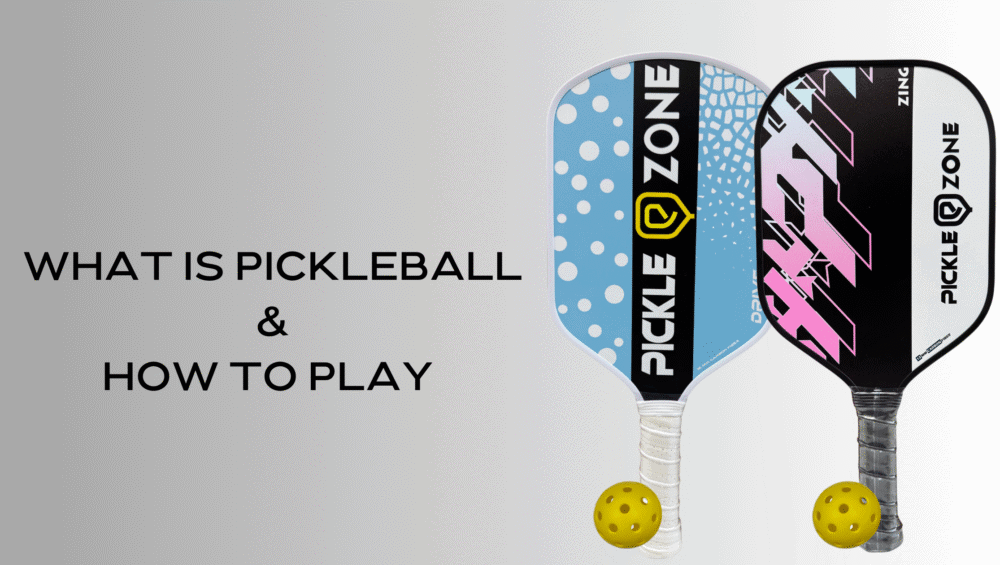
Pickleball is a paddle sport that combines elements of tennis, badminton and table tennis. It’s played on a badminton-sized court, using paddles (usually glass fiber, carbon fiber or wooden) a perforated plastic ball known as a “wiffle ball,” and a net similar to tennis but slightly lower.

The game originated in the United States in the 1960s, but in the last decade, it has exploded worldwide especially in countries like India where clubs, tournaments and coaching academies are growing rapidly.

What makes pickleball appealing is its gentle learning curve. Within your first session, you’ll likely be able to rally, serve and even attempt your first dink, a soft shot central to the sport. But don’t mistake simplicity for lack of depth: advanced players rely on strategy, precision, and high-level shot selection.


The Court and Equipment

1. Court Dimensions

A standard pickleball court is:

  • 20 feet wide
  • 44 feet long
  • Divided by a 34-inch net at the centre

The court layout includes:

  • Baseline – the back boundary line.
  • Sidelines – the side boundary lines.
  • Service areas – divided into right and left halves.
  • Non-Volley Zone (NVZ) or Kitchen – a 7-foot zone on each side of the net where volleys (hitting the ball before it bounces) are not allowed.

This kitchen rule makes the game more strategic and prevents constant aggressive smashes near the net.

2. Paddle

Pickleball paddles vary by material, thickness, weight and face texture. Beginners usually start with lightweight composite paddles, while intermediate and advanced players prefer raw carbon paddles for superior spin and control. 

3. Ball

Pickleball balls are plastic with holes.
There are two main types:

  • Indoor balls : Larger holes, slightly lighter.
  • Outdoor balls : Smaller holes, harder and more wind-resistant.

4. Footwear

Court shoes with good lateral support are ideal. Running shoes are not recommended because they lack side-to-side stability.


Basic Rules of Pickleball

1. Serving Rules

  • The serve is hit underhand.
  • Contact with the ball must be below the waist.
  • The paddle must move upwards, not sideways.
  • The serve must land diagonally across the court in the opposite service box.
  • Only one serve attempt is allowed (except in the rare case of a “let,” which most modern rules have removed).

In doubles, only the starting team’s second server gets a serve. After that, each team gets two serves per turn one per player.

2. The Double Bounce Rule

After the serve:

  1. The receiving team must let the ball bounce once before returning.
  2. The serving team must then let the return bounce once before hitting.

Only after these two bounces can players start volleying.

This rule is designed to increase rally length and ensure fair play.

3. Volleys and the Kitchen Rule

Volleying is allowed only outside the Non Volley Zone.

You cannot:

  • Volley while standing in the kitchen.
  • Let your momentum take you into the kitchen after volleying.
  • Touch the NVZ line during a volley.

You can:

  • Enter the kitchen after the ball has bounced.
  • Play dinks (soft shots) into this zone strategically.

4. Scoring System

Pickleball uses a rally based scoring system only for the serving team, meaning:

  • You score only when your team is serving.
  • Games are typically played to 11 points, win by 2.
  • Competitive matches may go to 15 or 21.

In doubles, the score is called as:
Serving team’s score – receiving team’s score – Server number (1 or 2).

Example:
“6–4–2” means the serving team has 6, opponents have 4, and player 2 is serving.

How to Play Pickleball: Step-by-Step Guide

1. Start with the Serve

The server stands behind the baseline on the right side and hits diagonally into the opponent’s service box. If the point is won, the server switches to the left side.

2. Establish Rally with Groundstrokes

Since both sides must let the ball bounce once, opening rallies often involve groundstrokes forehands and backhands hit after the bounce.

3. Advance to the Kitchen Line

A big strategy in pickleball is transitioning from the baseline to the non-volley line. Strong players aim to reach the kitchen line as early as possible because it gives them:

  • Better angles
  • Less court to cover
  • More strategic control

4. Dinking

Once at the kitchen line, the game shifts to soft, controlled exchanges known as dinks. These shots:

  • Are hit with a gentle upward motion
  • Land softly in the opponent’s NVZ
  • Force errors rather than seek winners

Pickleball is as much a mental battle as a physical one.

5. Drive, Drop, and Lob

Intermediate players learn three key shots:

  • Drive: A fast, powerful shot from mid-court.
  • Drop: A soft, arcing ball that lands in the kitchen.
  • Lob: A high shot over opponents at the net.

Balancing these shot choices is where true pickleball strategy emerges.

6. Winning the Point

Points are won through:

  • Forced errors
  • Shot placement
  • Opponent faults (hitting out, stepping into the kitchen during a volley, etc.)

Power matters, but precision and patience matter more.


Why Pickleball Is Growing So Fast

  • Easy to start, hard to master — perfect for all levels
  • Social and inclusive — doubles format enhances community
  • Small court, big fun — games are fast and energetic
  • Low impact — easier on joints than tennis

Whether you’re 12 or 70, pickleball offers both enjoyment and challenge.


Final Thoughts

Pickleball is an addictive, strategic, and incredibly fun sport that anyone can start playing in minutes. By understanding the basic rules—serving, the double-bounce rule, the kitchen rule—and practising simple shots, you’ll quickly feel comfortable on the court.

If you’re ready to get started, grab a paddle, find a local court or club, and jump into a game. Pickleball is not just a sport—it’s a community waiting to welcome you.

Are you a beginner then you must check this paddle and if you are an intermediate level player then do check this paddle. 

We also offer Pickleballs & Paddle Bags 
pickleball

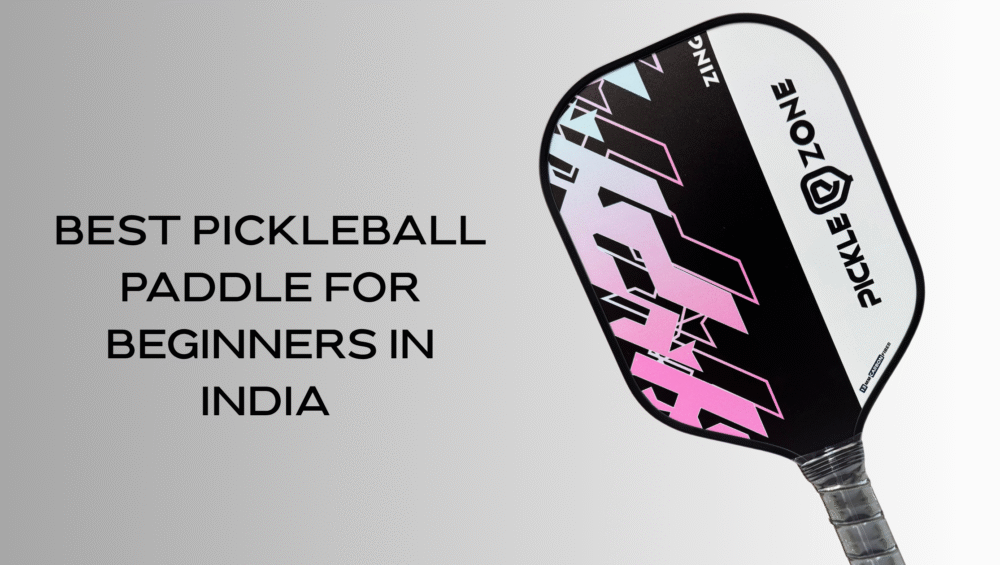
Best Pickleball Paddle for Beginners in India as of 2025

If you’re new to pickleball and searching for new Pickleball Paddles in India, the single most important decision you’ll make early on is your paddle. The paddle you learn with shapes your feel, confidence, and progress. After testing many beginner-friendly designs and studying product specs available in India, a paddle built to the following specification consistently stands out as the ideal starter tool :

Below I’ll explain like a coach who wants you to stick with the sport, why each of those numbers matters, how they help a beginner in India and where you can look to buy paddles that match these specifications.

Why 13 MM Core thickness is perfect for beginners

A 13 mm polymer core is a sweet spot between power and control. Thicker cores (13–14 mm) create more dwell time, the ball stays on the paddle a fraction longer which boosts control and forgiveness on off-center hits. That extra forgiveness is priceless for beginners still building consistent contact. Many beginner and intermediate paddles sold in India with carbon or hybrid faces use a 13 mm core to balance power without being overpowering. Examples of 13 mm offerings appear in India market listings and product pages (Amazon India)

Wide body = bigger sweet spot = fewer frustration points

Beginners miss the sweet spot more often than pros. A wide-body profile (greater blade width relative to length) noticeably enlarges the hitting surface so you make better contact more frequently. That reduces flubbed returns and lets you focus on movement and shot selection instead of worrying the paddle will “let you down.” Several “wide” models marketed in India explicitly advertise that extra face width and 13 mm cores for this reason (Zing 13 MM Carbon Fiber Paddle)

Carbon Fiber Smooth Surface : Durability + Consistent Response

A smooth carbon-fiber face delivers a crisp, predictable response and is more durable than cheaper fiberglass surfaces. For beginners, a predictable surface means your first attempts at spin, dinks and drives behave consistently; you learn technique, not compensatory habits. Several carbon-surface paddles available on Indian retail sites list 13 mm cores with carbon faces and weights around 226–227 g—right in the ideal beginner weight range. (Amazon India)

Dimensions and Grip Length : Balance and Control

The dimensions 400mm (length) and 190mm (width) make for a compact, maneuverable paddle with a broad face. That 400 mm overall length is short enough to be quick at the net but long enough for reach on drives. The 190mm width is the “wide” element that makes the paddle forgiving. A 13 mm grip length is modest and perfect for single-handed control; it keeps wrist action comfortable and prevents overlong handles that encourage two-handed grips (which beginners rarely need). Conversions and specs like these are regularly cited in Indian product descriptions. (Amazon India)

Weight : Why 227 gms is beginner-friendly

At 227 gms the paddle sits in the lightweight to midweight zone. Lighter paddles are easier to maneuver, help you react quickly at the kitchen line, and reduce fatigue during long practice sessions. Heavier paddles deliver more raw power but demand better technique and can stress the shoulder/arm for a beginner. Several 13 mm carbon options sold in India list item weights around 226–227 g—again matching the ideal specification. (Amazon India)

Practical buying advice for pickleball players in India (2025)

  1. Match the spec, not the sticker price. Seek paddles that explicitly list the 13 mm core, carbon face, dimensions roughly 400 Ă— 190 mm, and weight near 227 g. Indian retailers and marketplaces have started stocking these models from both global and local brands. Look at specialist retailers (sports stores that list pickleball gear) and established marketplaces where product pages show measured specs. (Pickle Zone)
  2. Try before you buy if possible. If there’s an academy or club near you (pickleball is growing fast in India), ask to demo a paddle with the same spec. If you can’t try it, buy from stores with a reasonable return policy.
  3. Edge guard and cover matter. Beginner paddles often come with an edge guard and cover keep both. Edge guards protect from court impacts; covers keep moisture and grit away.
  4. Grip replacement is cheap. If the grip feels too thin or thick, you can rewrap it cheaply. For 130 mm grip lengths, many players add an overgrip to tune circumference.
  5. Set a modest budget but avoid ultra-cheap imitations. There are inexpensive sets sold as “pickleball” but constructed from low-grade materials. Aim for paddles with clear technical specs and verified seller reviews. Several Indian vendors both local sports shops and online platforms—now list legitimate carbon-surface 13 mm paddles in a midprice bracket. (Pickle Zone)

Final verdict who this paddle is for

If you’re a beginner level pickleball player in India who wants a forgiving, durable, and technically sound paddle to build good habits, a 13 mm carbon fiber, wide-body paddle with 400 mm × 190 mm dimensions, a 130 mm grip and 227 g weight is one of the best starting points. It gives control, a big sweet spot for confidence, enough pop for growth, and a predictable surface to learn spin and touch.

pickleball

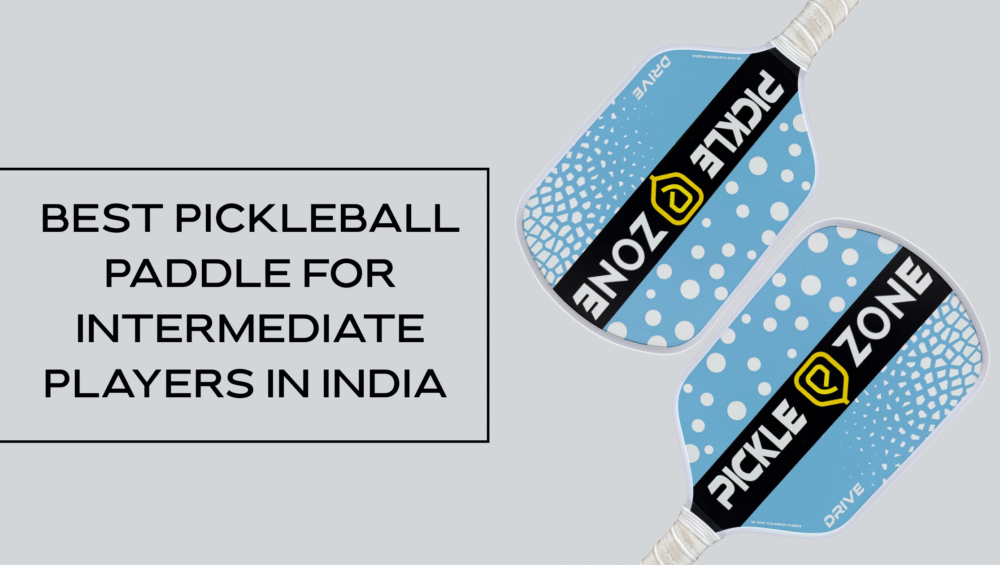
Best Pickleball Paddle for Intermediate Players in India as of 2025

If you’re an intermediate player in India ready to move past beginner paddles, then our 16 mm carbon fiber, extended paddle (410 mm length × 190 mm width), sand-gritted surface, 135 mm grip length, 230 g weight is exactly the kind of tool that will let your game blossom. Below we explain why those specs work, how they change your on-court options (and weaknesses), and what to look for when buying one in India today.

Why these specs match intermediate needs

16 mm core thickness (stability + softer feel). A 16 mm polymer/honeycomb core gives a slightly softer impact than very thin cores; that means more dwell time on the ball, better control on dinks and pushes, and less jarring at the elbow when you ramp up practice sessions. Many high-performance carbon paddles in the market use the 14–16 mm sweet spot to balance control and power.

Carbon fiber face spin and consistency. Raw/12K/18K Carbon surface are stiffer and transmit energy efficiently, letting intermediate players add spin and more precise placement without losing feel. In India, several premium paddles now feature T-700 / 12K carbon faces aimed at intermediate and advanced players. That face material complements a 16 mm core very well because the face stays true while the core cushions the contact.

Extended Paddle 410 mm length x 190 mm width elongated sweet spot. The extended (elongated) shape slightly stretches the sweet spot toward the tip, which helps players who want reach for angled drives and third-shot transitions. At 410 Ă— 190 mm, you retain a usable sweet spot while gaining a bit of extra length for reach and leverage on serves and overheads. Many elongated models sold to competitive players worldwide and in Indian retail channels adopt dimensions in this range.

Sand-gritted surface extra spin but careful with rules. A sand-gritted or friction surface increases ball bite and spin generation, which helps intermediate players who are learning to use topspin and side spin to control rallies. Be aware : some tournament rules and national bodies regulate how rough or textured a face may be; if you plan to play sanctioned events, check the paddle against tournament rules before competing. Indian retailers are stocking friction-surface paddles for players focusing on spin.

Grip length 135 mm and 230 g weight balance and manoeuvrability. A 135 mm grip length is comfortable for single-handed play and gives you enough handle to change grips quickly while volleying. At 230 grams, the paddle is in a medium-to-upper middle weight that gives power without being fatiguing for multi-hour practice sessions. For intermediates building muscle memory and smarts on the non-volley zone, this weight is an excellent compromise.

How this paddle changes your game practical takeaways

  • Dinks and touch: The thicker core softens the feel so you can control the ball at the kitchen line and develop consistent soft hands.
  • Spin and third-shot drops: The sand surface and carbon face make it easier to add spin to third-shot drops and approach shots great for moving up from baseline rallies to more tactical net play.
  • Power on drives: The 230 g mass stores and returns kinetic energy efficiently; you’ll see cleaner drives without swinging out of control.
  • Reach and placement: The elongated profile increases reach on the forehand and backhand tip area, helping when you’re stretched sideways or need long-angle shots.

What to watch out for (and how to mitigate)

  • Wrist strain during unnatural swings: Because carbon faces are stiffer, technique matters. Strengthen the wrist and forearm gradually and work on compact swings.
  • Surface wear in humid conditions: India’s climate can accelerate grit/surface wear. Rinse your paddle case and keep paddles out of hot cars; use a soft damp cloth (not solvents) for cleaning.
  • Tournament compliance: If you’ll enter sanctioned events, verify the paddle’s surface and roughness against the All India / tournament rules before buying. Several Indian vendors now list compliance details on product pages.

Where to buy in India (short guide)

By 2025, multiple Indian retailers and brands stock 16 mm carbon paddles and elongated models you’ll find options on Amazon India and when purchasing, check the product description for core thickness, face material, grip length, weight tolerance and whether the surface is marketed as “sand” or “raw carbon friction.” If possible, test different weights (225–235 g) to see what your arm prefers.  

Final verdict : Is this the best paddle for intermediates in India in 2025?

Yes – for intermediate players who prioritize control, spin and a slightly elongated sweet spot, a paddle built to the specifications you listed is one of the best matches available in India today. It blends the tactile advantages of a 16 mm core with the spin potential of a carbon, sand-grit face and the reach of an extended body. With the sport’s surge here (growing tournaments and expanding clubs across cities in 2025), these paddles are now readily available through multiple Indian suppliers  making this an ideal moment to upgrade.