
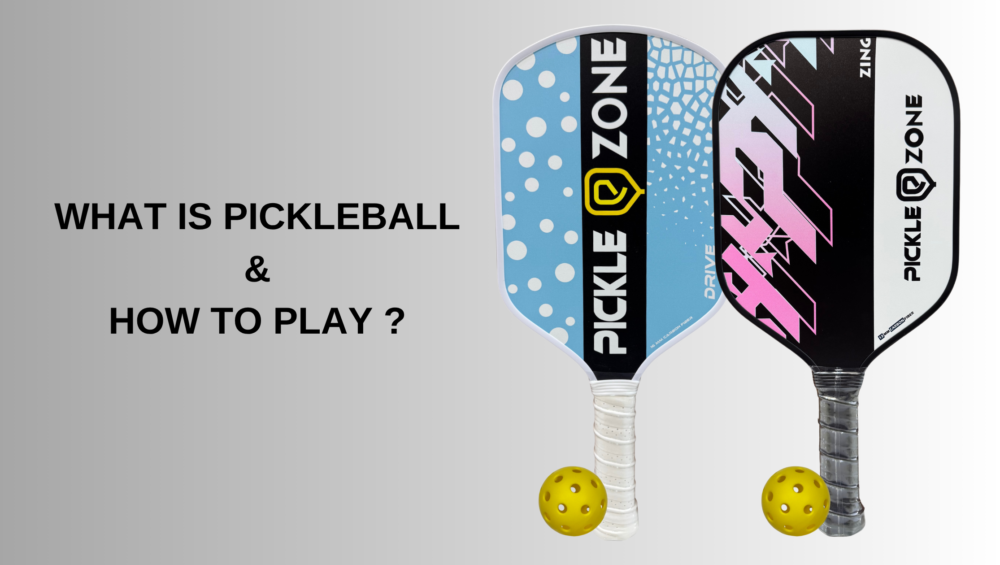
Pickleball is one of the fastest-growing sports in India & around the world, and for good reason. It’s fun, fast, social, easy to learn and suitable for players of nearly all ages. Whether you’ve seen those lively rallies happening at your local pickleball court or friends keep asking you to join a weekend game, this guide will walk you through the basics : what pickleball is, how it works and how you can start playing confidently.
What Is Pickleball?
Pickleball is a paddle sport that combines elements of tennis, badminton and table tennis. It’s played on a badminton-sized court, using paddles (usually glass fiber, carbon fiber or wooden) a perforated plastic ball known as a “wiffle ball,” and a net similar to tennis but slightly lower.
The game originated in the United States in the 1960s, but in the last decade, it has exploded worldwide especially in countries like India where clubs, tournaments and coaching academies are growing rapidly.
What makes pickleball appealing is its gentle learning curve. Within your first session, you’ll likely be able to rally, serve and even attempt your first dink, a soft shot central to the sport. But don’t mistake simplicity for lack of depth: advanced players rely on strategy, precision, and high-level shot selection.
The Court and Equipment
1. Court Dimensions
A standard pickleball court is:
- 20 feet wide
- 44 feet long
- Divided by a 34-inch net at the centre
The court layout includes:
- Baseline – the back boundary line.
- Sidelines – the side boundary lines.
- Service areas – divided into right and left halves.
- Non-Volley Zone (NVZ) or Kitchen – a 7-foot zone on each side of the net where volleys (hitting the ball before it bounces) are not allowed.
This kitchen rule makes the game more strategic and prevents constant aggressive smashes near the net.
2. Paddle
Pickleball paddles vary by material, thickness, weight and face texture. Beginners usually start with lightweight composite paddles, while intermediate and advanced players prefer raw carbon paddles for superior spin and control.
3. Ball
Pickleball balls are plastic with holes.
There are two main types:
- Indoor balls : Larger holes, slightly lighter.
- Outdoor balls : Smaller holes, harder and more wind-resistant.
4. Footwear
Court shoes with good lateral support are ideal. Running shoes are not recommended because they lack side-to-side stability.
Basic Rules of Pickleball
1. Serving Rules
- The serve is hit underhand.
- Contact with the ball must be below the waist.
- The paddle must move upwards, not sideways.
- The serve must land diagonally across the court in the opposite service box.
- Only one serve attempt is allowed (except in the rare case of a “let,” which most modern rules have removed).
In doubles, only the starting team’s second server gets a serve. After that, each team gets two serves per turn one per player.
2. The Double Bounce Rule
After the serve:
- The receiving team must let the ball bounce once before returning.
- The serving team must then let the return bounce once before hitting.
Only after these two bounces can players start volleying.
This rule is designed to increase rally length and ensure fair play.
3. Volleys and the Kitchen Rule
Volleying is allowed only outside the Non Volley Zone.
You cannot:
- Volley while standing in the kitchen.
- Let your momentum take you into the kitchen after volleying.
- Touch the NVZ line during a volley.
You can:
- Enter the kitchen after the ball has bounced.
- Play dinks (soft shots) into this zone strategically.
4. Scoring System
Pickleball uses a rally based scoring system only for the serving team, meaning:
- You score only when your team is serving.
- Games are typically played to 11 points, win by 2.
- Competitive matches may go to 15 or 21.
In doubles, the score is called as:
Serving team’s score – receiving team’s score – Server number (1 or 2).
Example:
“6–4–2” means the serving team has 6, opponents have 4, and player 2 is serving.
How to Play Pickleball: Step-by-Step Guide
1. Start with the Serve
The server stands behind the baseline on the right side and hits diagonally into the opponent’s service box. If the point is won, the server switches to the left side.
2. Establish Rally with Groundstrokes
Since both sides must let the ball bounce once, opening rallies often involve groundstrokes forehands and backhands hit after the bounce.
3. Advance to the Kitchen Line
A big strategy in pickleball is transitioning from the baseline to the non-volley line. Strong players aim to reach the kitchen line as early as possible because it gives them:
- Better angles
- Less court to cover
- More strategic control
4. Dinking
Once at the kitchen line, the game shifts to soft, controlled exchanges known as dinks. These shots:
- Are hit with a gentle upward motion
- Land softly in the opponent’s NVZ
- Force errors rather than seek winners
Pickleball is as much a mental battle as a physical one.
5. Drive, Drop, and Lob
Intermediate players learn three key shots:
- Drive : A fast, powerful shot from mid-court.
- Drop : A soft, arcing ball that lands in the kitchen.
- Lob : A high shot over opponents at the net.
Balancing these shot choices is where true pickleball strategy emerges.
6. Winning the Point
Points are won through:
- Forced errors
- Shot placement
- Opponent faults (hitting out, stepping into the kitchen during a volley, etc.)
Power matters, but precision and patience matter more.
Why Pickleball Is Growing So Fast
- Easy to start, hard to master : perfect for all levels
- Social and inclusive : doubles format enhances community
- Small court, big fun : games are fast and energetic
- Low impact : easier on joints than tennis
Whether you’re 12 or 70, pickleball offers both enjoyment and challenge.
Final Thoughts
Pickleball is an addictive, strategic, and incredibly fun sport that anyone can start playing in minutes. By understanding the basic rules serving, the double-bounce rule, the kitchen rule and practising simple shots, you’ll quickly feel comfortable on the court.
If you’re ready to get started, grab a paddle, find a local court or club, and jump into a game. Pickleball is not just a sport it’s a community waiting to welcome you.
Are you a beginner then you must check this paddle and if you are an intermediate level player then do check this paddle.
We also offer Pickleballs & Paddle Bags


